What Type of Molecule Carries Amino Acids to the Ribosome During Protein Synthesis?
Learning Objectives
- Describe the biochemical structure of ribonucleotides
- Describe the similarities and differences between RNA and Dna
- Describe the functions of the three main types of RNA used in protein synthesis
- Explain how RNA tin serve equally hereditary information
Structurally speaking, ribonucleic acrid (RNA), is quite similar to DNA. However, whereas DNA molecules are typically long and double stranded, RNA molecules are much shorter and are typically single stranded. RNA molecules perform a multifariousness of roles in the jail cell but are mainly involved in the process of protein synthesis (translation) and its regulation.
RNA Structure
RNA is typically unmarried stranded and is made of ribonucleotides that are linked by phosphodiester bonds. A ribonucleotide in the RNA chain contains ribose (the pentose sugar), one of the four nitrogenous bases (A, U, G, and C), and a phosphate group. The subtle structural difference between the sugars gives DNA added stability, making Dna more than suitable for storage of genetic information, whereas the relative instability of RNA makes it more suitable for its more than short-term functions. The RNA-specific pyrimidine uracil forms a complementary base pair with adenine and is used instead of the thymine used in DNA. Even though RNA is single stranded, nigh types of RNA molecules testify extensive intramolecular base pairing between complementary sequences inside the RNA strand, creating a predictable three-dimensional structure essential for their function (Figure 1 and Figure 2).

Figure ane. (a) Ribonucleotides contain the pentose sugar ribose instead of the deoxyribose found in deoxyribonucleotides. (b) RNA contains the pyrimidine uracil in place of thymine found in DNA.
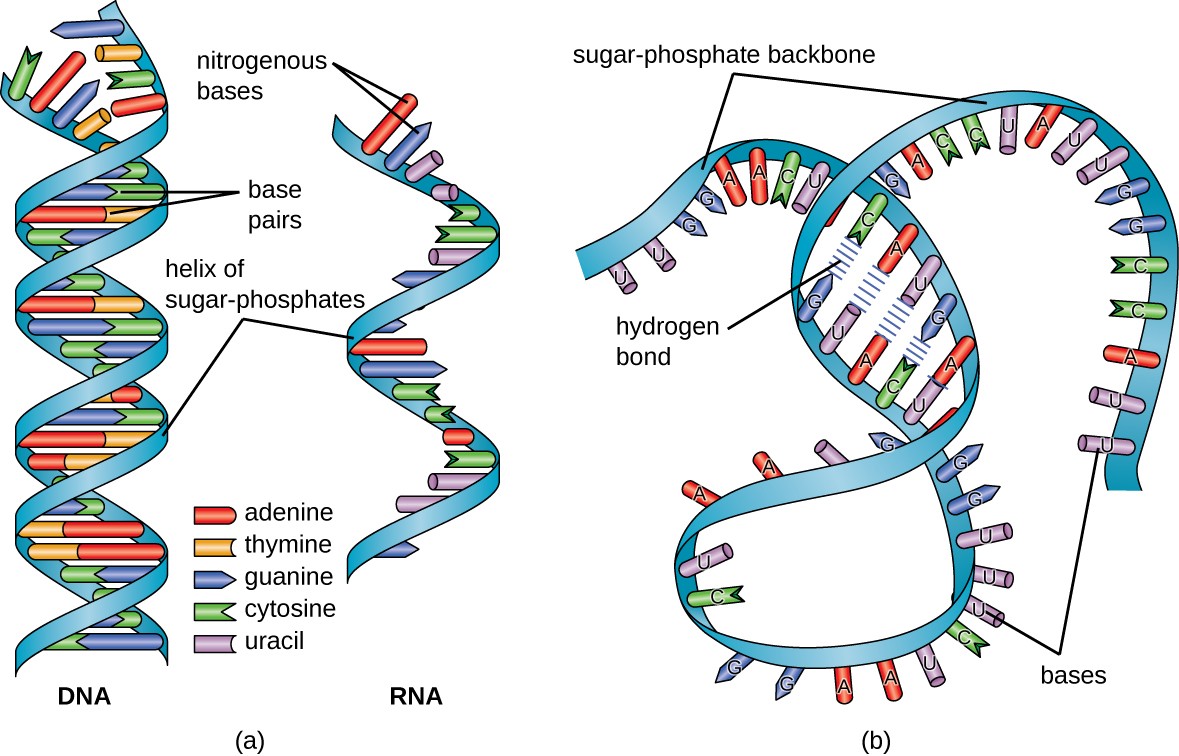
Figure two. (a) Dna is typically double stranded, whereas RNA is typically unmarried stranded. (b) Although it is unmarried stranded, RNA can fold upon itself, with the folds stabilized past short areas of complementary base pairing inside the molecule, forming a three-dimensional structure.
Recollect about It
- How does the construction of RNA differ from the structure of Deoxyribonucleic acid?
Functions of RNA in Poly peptide Synthesis
Cells access the information stored in Dna past creating RNA to direct the synthesis of proteins through the process of translation. Proteins inside a jail cell have many functions, including building cellular structures and serving equally enzyme catalysts for cellular chemical reactions that give cells their specific characteristics. The iii main types of RNA directly involved in protein synthesis are messenger RNA (mRNA), ribosomal RNA (rRNA), and transfer RNA (tRNA).
In 1961, French scientists François Jacob and Jacques Monod hypothesized the being of an intermediary between DNA and its poly peptide products, which they chosen messenger RNA.[ane] Show supporting their hypothesis was gathered shortly afterwards showing that data from DNA is transmitted to the ribosome for protein synthesis using mRNA. If DNA serves as the complete library of cellular data, mRNA serves as a photocopy of specific data needed at a particular point in time that serves every bit the instructions to make a protein.
The mRNA carries the message from the DNA, which controls all of the cellular activities in a prison cell. If a cell requires a certain poly peptide to exist synthesized, the gene for this product is "turned on" and the mRNA is synthesized through the process of transcription (see RNA Transcription). The mRNA then interacts with ribosomes and other cellular machinery (Effigy 3) to direct the synthesis of the protein information technology encodes during the process of translation (meet Protein Synthesis). mRNA is relatively unstable and short-lived in the cell, specially in prokaryotic cells, ensuring that proteins are only fabricated when needed.

Effigy 3. A generalized illustration of how mRNA and tRNA are used in poly peptide synthesis inside a cell.
rRNA and tRNA are stable types of RNA. In prokaryotes and eukaryotes, tRNA and rRNA are encoded in the Deoxyribonucleic acid, then copied into long RNA molecules that are cut to release smaller fragments containing the individual mature RNA species. In eukaryotes, synthesis, cutting, and associates of rRNA into ribosomes takes identify in the nucleolus region of the nucleus, just these activities occur in the cytoplasm of prokaryotes. Neither of these types of RNA carries instructions to direct the synthesis of a polypeptide, merely they play other important roles in protein synthesis.
Ribosomes are equanimous of rRNA and protein. As its name suggests, rRNA is a major elective of ribosomes, composing up to almost 60% of the ribosome by mass and providing the location where the mRNA binds. The rRNA ensures the proper alignment of the mRNA, tRNA, and the ribosomes; the rRNA of the ribosome also has an enzymatic activity (peptidyl transferase) and catalyzes the formation of the peptide bonds betwixt 2 aligned amino acids during protein synthesis. Although rRNA had long been thought to serve primarily a structural role, its catalytic role within the ribosome was proven in 2000.[2] Scientists in the laboratories of Thomas Steitz (1940–) and Peter Moore (1939–) at Yale University were able to crystallize the ribosome structure from Haloarcula marismortui, a halophilic archaeon isolated from the Dead Sea. Considering of the importance of this work, Steitz shared the 2009 Nobel Prize in Chemistry with other scientists who made significant contributions to the understanding of ribosome construction.
Transfer RNA is the third main type of RNA and i of the smallest, unremarkably only 70–90 nucleotides long. It carries the correct amino acrid to the site of protein synthesis in the ribosome. It is the base of operations pairing betwixt the tRNA and mRNA that allows for the correct amino acrid to be inserted in the polypeptide chain being synthesized (Figure 4). Whatever mutations in the tRNA or rRNA can result in global issues for the cell considering both are necessary for proper protein synthesis (Tabular array ane).

Figure 4. A tRNA molecule is a unmarried-stranded molecule that exhibits pregnant intracellular base pairing, giving it its characteristic three-dimensional shape.
| Table 1. Structure and Function of RNA | |||
|---|---|---|---|
| mRNA | rRNA | tRNA | |
| Structure | Short, unstable, unmarried-stranded RNA corresponding to a cistron encoded inside Dna | Longer, stable RNA molecules composing 60% of ribosome's mass | Brusque (70-xc nucleotides), stable RNA with all-encompassing intramolecular base pairing; contains an amino acid binding site and an mRNA binding site |
| Part | Serves as intermediary between Deoxyribonucleic acid and protein; used by ribosome to direct synthesis of protein information technology encodes | Ensures the proper alignment of mRNA, tRNA, and ribosome during protein synthesis; catalyzes peptide bail formation between amino acids | Carries the right amino acid to the site of poly peptide synthesis in the ribosome |
Recollect about Information technology
- What are the functions of the 3 major types of RNA molecules involved in protein synthesis?
RNA as Hereditary Information
Although RNA does non serve equally the hereditary information in most cells, RNA does hold this function for many viruses that practise not contain Deoxyribonucleic acid. Thus, RNA conspicuously does have the boosted chapters to serve as genetic data. Although RNA is typically single stranded within cells, there is significant diversity in viruses. Rhinoviruses, which cause the common cold; influenza viruses; and the Ebola virus are single-stranded RNA viruses. Rotaviruses, which cause astringent gastroenteritis in children and other immunocompromised individuals, are examples of double-stranded RNA viruses. Because double-stranded RNA is uncommon in eukaryotic cells, its presence serves as an indicator of viral infection. The implications for a virus having an RNA genome instead of a Deoxyribonucleic acid genome are discussed in more than detail in Viruses.
Key Concepts and Summary
- Ribonucleic acid (RNA) is typically single stranded and contains ribose every bit its pentose carbohydrate and the pyrimidine uracil instead of thymine. An RNA strand can undergo significant intramolecular base pairing to take on a three-dimensional structure.
- There are three principal types of RNA, all involved in protein synthesis.
- Messenger RNA (mRNA) serves as the intermediary betwixt Dna and the synthesis of protein products during translation.
- Ribosomal RNA (rRNA) is a type of stable RNA that is a major constituent of ribosomes. It ensures the proper alignment of the mRNA and the ribosomes during poly peptide synthesis and catalyzes the formation of the peptide bonds between two aligned amino acids during protein synthesis.
- Transfer RNA (tRNA) is a small type of stable RNA that carries an amino acid to the corresponding site of protein synthesis in the ribosome. Information technology is the base pairing between the tRNA and mRNA that allows for the correct amino acrid to exist inserted in the polypeptide chain being synthesized.
- Although RNA is non used for long-term genetic data in cells, many viruses exercise utilize RNA as their genetic fabric.
Multiple Choice
Which of the following types of RNA codes for a protein?
- dsRNA
- mRNA
- rRNA
- tRNA
Show Answer
Respond b. mRNA codes for a protein.
A nucleic acrid is purified from a mixture. The molecules are relatively small, incorporate uracil, and most are covalently jump to an amino acid. Which of the following was purified?
- Deoxyribonucleic acid
- mRNA
- rRNA
- tRNA
Evidence Answer
Answer d. tRNA was purified.
Which of the following types of RNA is known for its catalytic abilities?
- dsRNA
- mRNA
- rRNA
- tRNA
Evidence Answer
Reply c. rRNA is known for its catalytic abilities.
Ribosomes are composed of rRNA and what other component?
- protein
- polypeptides
- Dna
- mRNA
Testify Answer
Reply a. Ribosomes are composed of rRNA and protein.
Which of the post-obit may use RNA as its genome?
- a bacterium
- an archaeon
- a virus
- a eukaryote
Show Answer
Answer c. A virus may use RNA as its genome.
Matching
Friction match the correct molecule with its clarification:
| ___tRNA | A. is a major component of ribosome |
| ___rRNA | B. is a copy of the data in a gene |
| ___mRNA | C. carries an amino acid to the ribosome |
Truthful/False
Ribosomes are composed mostly of RNA.
Double-stranded RNA is ordinarily found inside cells.
Think about It
- What are the differences between DNA nucleotides and RNA nucleotides?
- How is the information stored within the base sequence of Deoxyribonucleic acid used to determine a prison cell'due south properties?
- How do complementary base of operations pairs contribute to intramolecular base of operations pairing within an RNA molecule?
- If an antisense RNA has the sequence 5ʹAUUCGAAUGC3ʹ, what is the sequence of the mRNA to which it will bind? Be sure to label the 5ʹ and 3ʹ ends of the molecule you draw.
- Why does double-stranded RNA (dsRNA) stimulate RNA interference?
- Why does information technology make sense that tRNA and rRNA molecules are more stable than mRNA molecules?
- Place the location of mRNA, rRNA, and tRNA in the effigy.

muldoondinclect66.blogspot.com
Source: https://courses.lumenlearning.com/microbiology/chapter/structure-and-function-of-rna/
0 Response to "What Type of Molecule Carries Amino Acids to the Ribosome During Protein Synthesis?"
Post a Comment