What State Has the Highest Inter Family Marriage
American sexual beliefs is much different than it used to be. Today, most Americans think premarital sexual activity is okay, and will have three or more sexual partners before marrying. What, if anything, does premarital sex have to practise with marital stability?
This research brief shows that the relationship between divorce and the number of sexual partners women have prior to marriage is circuitous. I explore this human relationship using data from the 3 most recent waves of the National Survey of Family Growth (NSFG) collected in 2002, 2006-2010, and 2011-2013. For women marrying since the start of the new millennium:
- Women with 10 or more partners werethe most probable to divorce, but this only became true in recent years;
- Women with 3-9 partners wereless likelyto divorce than women with ii partners; and,
- Women with 0-1 partners were theleast likely to divorce.
Earlier research institute that having multiple sex activity partners prior to spousal relationship could lead to less happy marriages, and often increased the odds of divorce. But sexual attitudes and behaviors continue to modify in America, and some of the strongest predictors of divorce in years gone by no longer matter as much as they once did. In my 2005 volumeUnderstanding the Divorce Cycle, I showed that the transmission of divorce between generations became weaker as divorce grew more common. Could the same affair have happened with sexual behavior? Somewhat surprisingly, the answer appears to exist no.
Even more noteworthy has been the reject in the proportion of women who become married having had only one sexual practice partner (in well-nigh cases, their futurity husbands). 40-iii percent of women had just one premarital sex partner in the 1970s. By the aughts, this was down to 21 percent. Neither of these 2 trends changed much after the start decade of the 20-start century. Post-obit in the wake of the sexual revolution, the 1970s have been characterized as a decade of carnal exploration. But this doesn't seem to have been the example for the vast majority of women who ultimately tied the knot in that decade: almost two-thirds of them had at well-nigh 1 sexual activity partner prior to getting married. Fifty-fifty in the 1980s, slightly over half of women had a maximum of i sexual practice partner before walking downwards the alley. Things looked very dissimilar at the showtime of the new millennium.
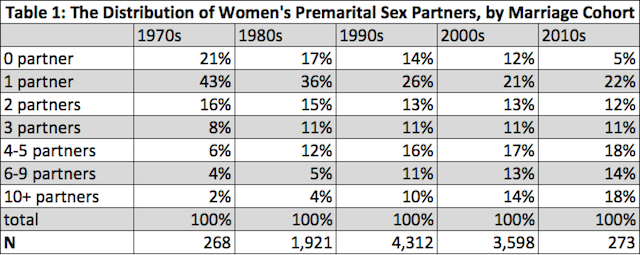
By the 2010s, only 5 percent of new brides were virgins. At the other end of the distribution, the number of futurity wives who had 10 or more than sexual practice partners increased from 2 percentage in the 1970s to 14 percent in the 2000s, and and so to eighteen percent in the 2010s. Overall, American women are far more likely to have had multiple premarital sex partners in contempo years (unfortunately, the NSFG doesn't have full information on men'southward premarital sexual behavior, and in any event they recall their own marital histories less reliably than do women).
As premarital sexual practice became more adequate, information technology'due south reasonable to anticipate that its negative effects on marital stability waned. In full general, Americans became more than accepting of nonmarital sex activity. Certainly fewer men entered union with the expectation of a virgin bride. All of the fanfare associated with hooking up is bear witness that some immature people have become comfy with the idea of sex outside of serious relationships.
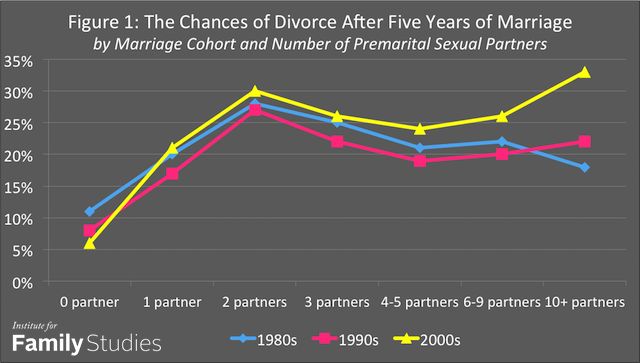
Exist that as it may, this prediction is only partially borne out by the data shown in Figure 1. The post-obit chart depicts the percentage of first marriages ending in divorce within five years of wedlock according to the decade the wedding took identify and how many sexual activity partners a woman had prior to marriage.1 Consistent with prior research, those with fewer sex partners were less probable to divorce. Still, there are considerable differences by marriage cohort. For all three cohorts, women who married equally virgins had the lowest divorce rates by far. Eleven percent of virgin marriages (on the part of the woman, at least) in the 1980s dissolved within v years. This number fell to 8 pct in the 1990s, then vicious once more to half-dozen percentage in the 2000s. For all 3 decades, the women with the second lowest five-year divorce rates are those who had simply i partner prior to marriage. Information technology's reasonable to assume that these partners reflected women's eventual husbands. However, premarital sex with one partner essentially increases the odds of divorce.
In the 1980s and 1990s, the highest five-year divorce rates were reserved for women who had two partners. The effect was particularly potent in the 1980s, when these women had divorce rates of 28 percent, substantially higher than those of their peers who had ten or more sex partners prior to marriage (18 percent). Even in the aughts, women who had two partners had, at 30 per centum, the 2nd highest divorce rates in the table.
The highest 5-yr divorce rates of all are associated with marrying in the 2000s and having ten or more than premarital sex partners: 33 percent. Possibly information technology is non unexpected that having many partners increases the odds of divorce. The greater surprise is that this only holds truthful in recent years; previously, women with two partners prior to matrimony had the highest divorce rates.
Source: NSFG, 2002-2013
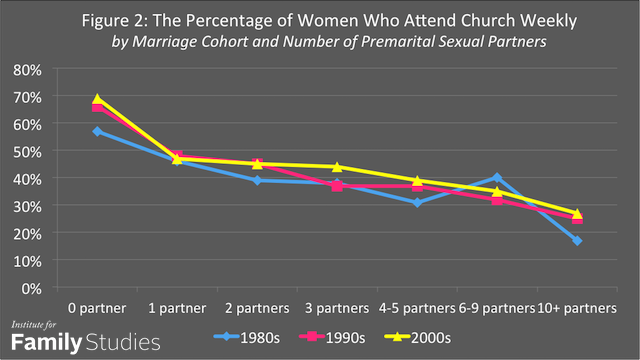
How can these findings exist explained? It's easiest to brand sense of the depression divorce rates of people with minimal sexual experience prior to wedlock. Plainly, one of the well-nigh common reasons for premarital abstinence is faith, and NSFG information support such an interpretation.2 Figure two shows that women who marry as virgins are far more likely than other women to attend church at least once a calendar week. It's likewise noteworthy that virgin marriages increasingly became the domain of religious women between the 1980s and 2000s—and during the aforementioned years, the divorce charge per unit for virgin brides continued to drop. These findings brand sense in light of the fact that people who attend church ofttimes have lower divorce rates than do not-participants.
Source: NSFG, 2002-2013
By and large speaking, women who have multiple sexual activity partners are less likely to be regular churchgoers. Since women with many partners don't consistently take high divorce rates, there is niggling reason to suspect that organized religion is an important caption for the relationship betwixt sexual practice partners and divorce outside of women who marry having had one or no partners.
Women who marry having had just one sex partner are unlikely to take had children with another human. Getting married with a kid already in tow has a profound negative effect on marital happiness. And marriages preceded by nonmarital fertility have disproportionately high divorce rates. This is another reason why divorce rates are lower for women who ally having had merely one sexual activity partner, or none at all. Ultimately we're left to speculate about why having exactly two partners produces some of the highest divorce rates.
My all-time guess rests on the notion ofover-emphasized comparisons. In well-nigh cases, a woman'due south two premarital sexual practice partners include her time to come married man and one other human being. That second sexual activity partner is first-paw proof of a sexual alternative to one's husband. These sexual experiences convince women that sex activity outside of wedlock is indeed a possibility. The man involved was probable to take become a partner in the course of a serious human relationship—women inclined to claw up will have had more than two premarital partners—thereby emphasizing the seriousness of the alternative. Of course, women learn about the viability of nonmarital sex if they have multiple premarital partners, but with multiple partners, each one represents a smaller part of a adult female's sexual and romantic biography. Having two partners may lead to uncertainty, but having a few more manifestly leads to greater clarity near the right man to marry. The odds of divorce are everyman with goose egg or one premarital partners, but otherwise sowing one's oats seems uniform with having a lasting marriage.
Only not also many oats, if one married after the get-go of the new millennium. The highest divorce rates shown in Figure 1, 33 per centum, vest to women who had ten or more premarital sex activity partners. This is the consequence most readers of this brief probably expected: a lot of partners means a lot of baggage, which makes a stable marriage less tenable. It's also entirely likely that the correlation is spurious, the product of certain personal characteristics. For instance, people who suffered childhood sexual abuse are more likely to have extensive sexual histories. Childhood abuse besides increases the odds of a problematic marriage.
This is an extreme instance. Most of the time, spuriousness probably has less measurable causes. Some people may just take a high level of sexual curiosity, an attribute that doesn't appear to bode well for a stable marriage, at least since the showtime of the new millennium.
The odds of divorce are lowest with nada or one premarital partners.
Two caveats are in order. First, the 33 percent divorce figure for women with ten or partners who married in the 2000s is non statistically significantly higher than the 30 percent five-twelvemonth divorce charge per unit for women who had two partners. Second, it is unknown as to why having ten or more partners has get more strongly linked to divorce only recently. This is a surprising development given the increasing frequency of having multiple partners, likewise as people's greater overall credence of premarital sexuality. Perhaps this acceptance is more complex than has been acknowledged. Having a scattering of sex activity partners—anywhere between three and nine—may be perfectly acceptable, but more than than that is problematic for marriage in a way it didn't used to exist. In any consequence, a total agreement is across the scope of this report.
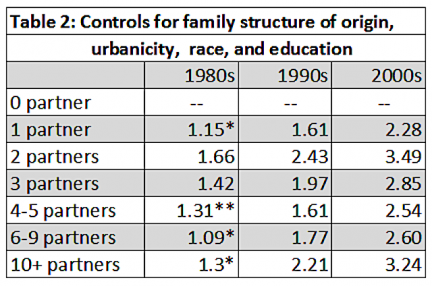
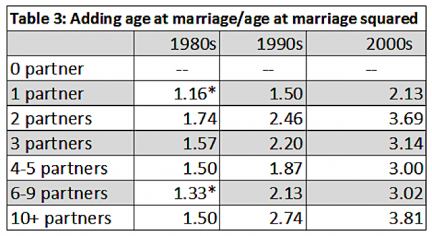
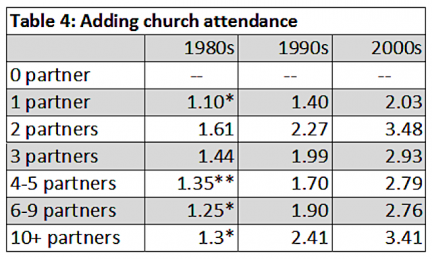
Finally, I sought to explain the relationship between premarital sexuality and marital stability via multivariate analysis. Generally speaking, major social and demographic differences between survey respondents explain but a small portion of the human relationship between numbers of sex partners and marital stability. At best, these differences account for most one quarter of the observed association between sex partners and divorce. At worst, they make essentially no difference. Due to the design of the NSFG, a limited number of socio-demographic variables were amenable to analysis, including race, family structure of origin, urban vs. rural residence, age at marriage, and church building attendance.
Aside from religion, race and family unit of origin accounted for the largest portion of the sexual partners/divorce human relationship. Caucasian and African American women had similar premarital sexual behavior, just Latinas and members of the "Other" population group had notably fewer sex partners and lower divorce rates than either whites or blacks. Similarly, people who grew upwards without both parents had more partners and divorced more. Detailed psychometric data would be necessary to further explicate the relationship between numbers of sex partners and marital stability.
Information technology won't be surprising to most readers that people with more premarital sex partners take higher divorce rates, broadly speaking. That said, this research brief paints a adequately complicated movie of the association between sex activity and marital stability that ultimately raises more questions than it answers.
Nicholas H. Wolfinger is Professor of Family and Consumer Studies and Offshoot Professor of Sociology at the University of Utah. His nigh recent volume is Soul Mates: Religion, Sex, Children, and Matrimony among African Americans and Latinos, coauthored with West. Bradford Wilcox (Oxford University Printing, 2016).
one. The effigy depicts life table five-twelvemonth marriage failure rates. The sample sizes are too pocket-sized to await at sex partners and divorce for marriages formed in the 1970s and the 2010s. Likewise, the data don't permit the analysis of aforementioned-sex marriage.
two. Some caveats. First, although church omnipresence is a good measure of religious involvement, it doesn't fully capture religiosity. Second and more important is the fact that church attendance is measured at the time of the NSFG interview, and so it might exist a consequence every bit well as a crusade of marital beliefs. Divorce affects religious participation: female person NSFG respondents are near 25 pct less likely to nourish church frequently compared to married women. Accordingly, findings concerning faith should be viewed every bit suggestive rather than definitive.
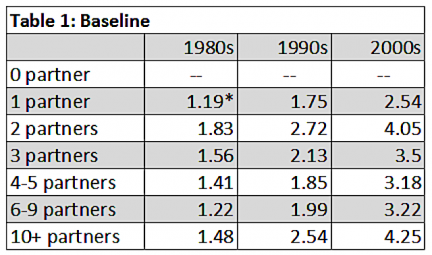
Appendix:Cox Regression Estimates of the Effects of Premarital Sexual activity Partners and Other Factors on Women's Marital Stability in Beginning Marriages (Tables one - four)
Notation: Results are hazard ratios indicating increased odds of divorce compared to reference category of 0 partners (total abstinence before marriage). For example, Tabular array 1 shows that women who married in the 1990s and had one premarital sex activity partner had 75% higher odds of divorce compared to women who married as virgins in the 1990s.
For all tables, Ns are:
1980s: ane,899
1990s: 4,292
2000s: 3,597
Ns are too pocket-sized for analysis of divorce and sex partners for people marrying in the 1970s and the 2010s.
* = non significant
** = p < .10
muldoondinclect66.blogspot.com
Source: https://ifstudies.org/blog/counterintuitive-trends-in-the-link-between-premarital-sex-and-marital-stability
0 Response to "What State Has the Highest Inter Family Marriage"
Post a Comment